
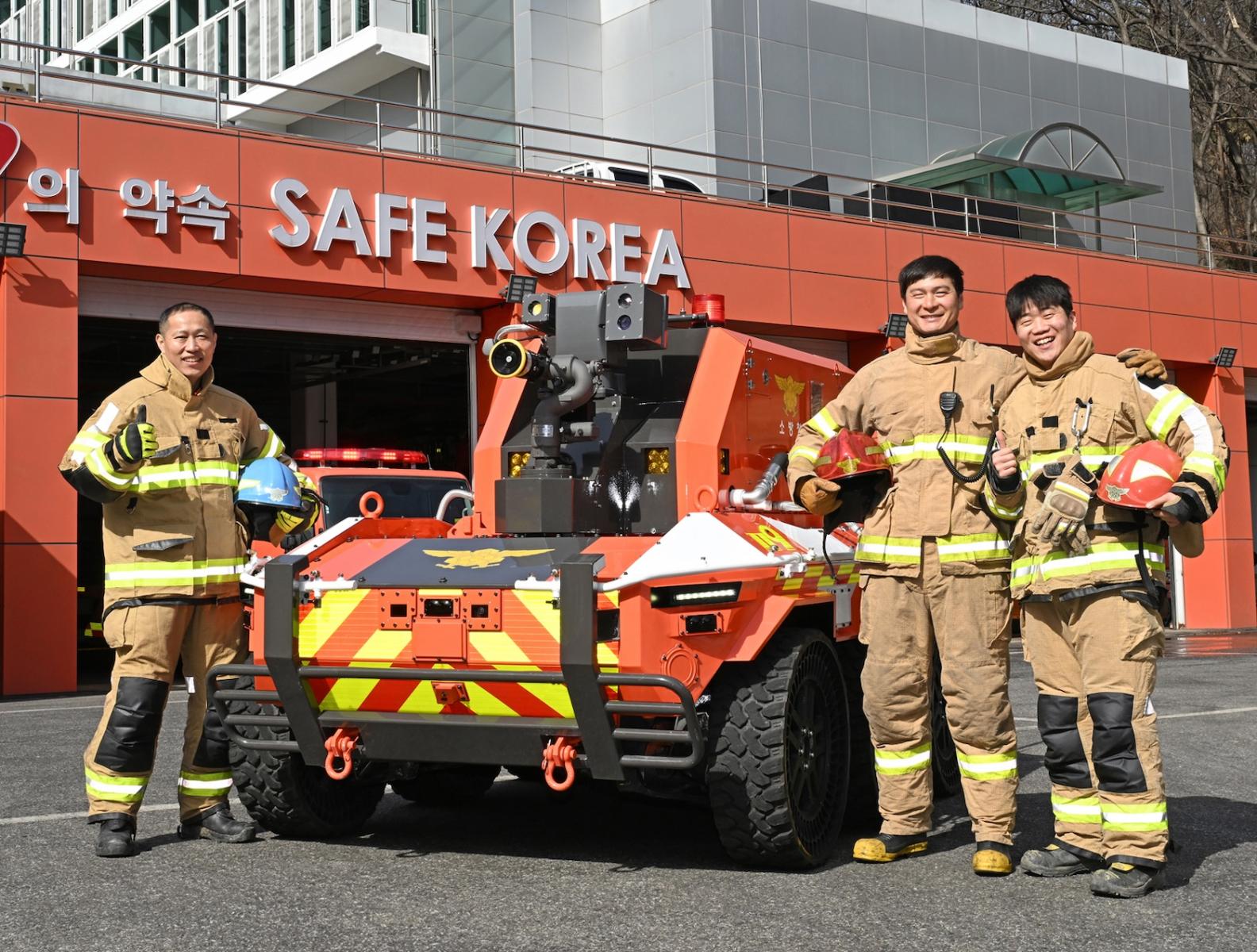
Hyundai Motor Group (the Group) today released a video, ‘A Safer Way Home,’ introducing the Unmanned Firefighting Robot — first unveiled and donated to the National Fire Agency at an official ceremony held on February 24, 2026.
The Unmanned Firefighting Robot is an advanced mobility solution designed for deployment in active fire scenes and represents a next-generation disaster response platform created through the cooperation of Hyundai Motor Company, Kia, Hyundai Rotem, Hyundai Mobis and the National Fire Agency. Through this campaign, the Group aims to show the value of robot technology that protects and rescues people.

How Does the Unmanned Firefighting Robot Enhance Firefighter Safety?
The Unmanned Firefighting Robot is preemptively deployed to high-risk fire scenes that are difficult for firefighters to enter due to risks of collapse, explosion, high temperatures, toxic gas or dense smoke. It remotely identifies and assesses the situation, approaches the fire’s source and directly extinguishes the blaze. By tackling dangerous situations in place of people, the robot ultimately protects the lives and safety of firefighters and citizens.
The campaign video delivers a raw, vivid message featuring the voices, photos and actual field footage of active-duty firefighters explaining the dangers of their missions. Im Pal Soon, a rescue team leader from the Central 119 Rescue Headquarters who operates the Unmanned Firefighting Robots, appears in the video and provides narration, adding to the message’s sincerity.
The video also includes footage from a factory fire tackled by an Unmanned Firefighting Robot in North Chungcheong Province, South Korea, on January 30. This marked the first real-world use case for the technology, demonstrating its practicality and field-readiness.
What are the Robot’s Key Features and Capabilities?
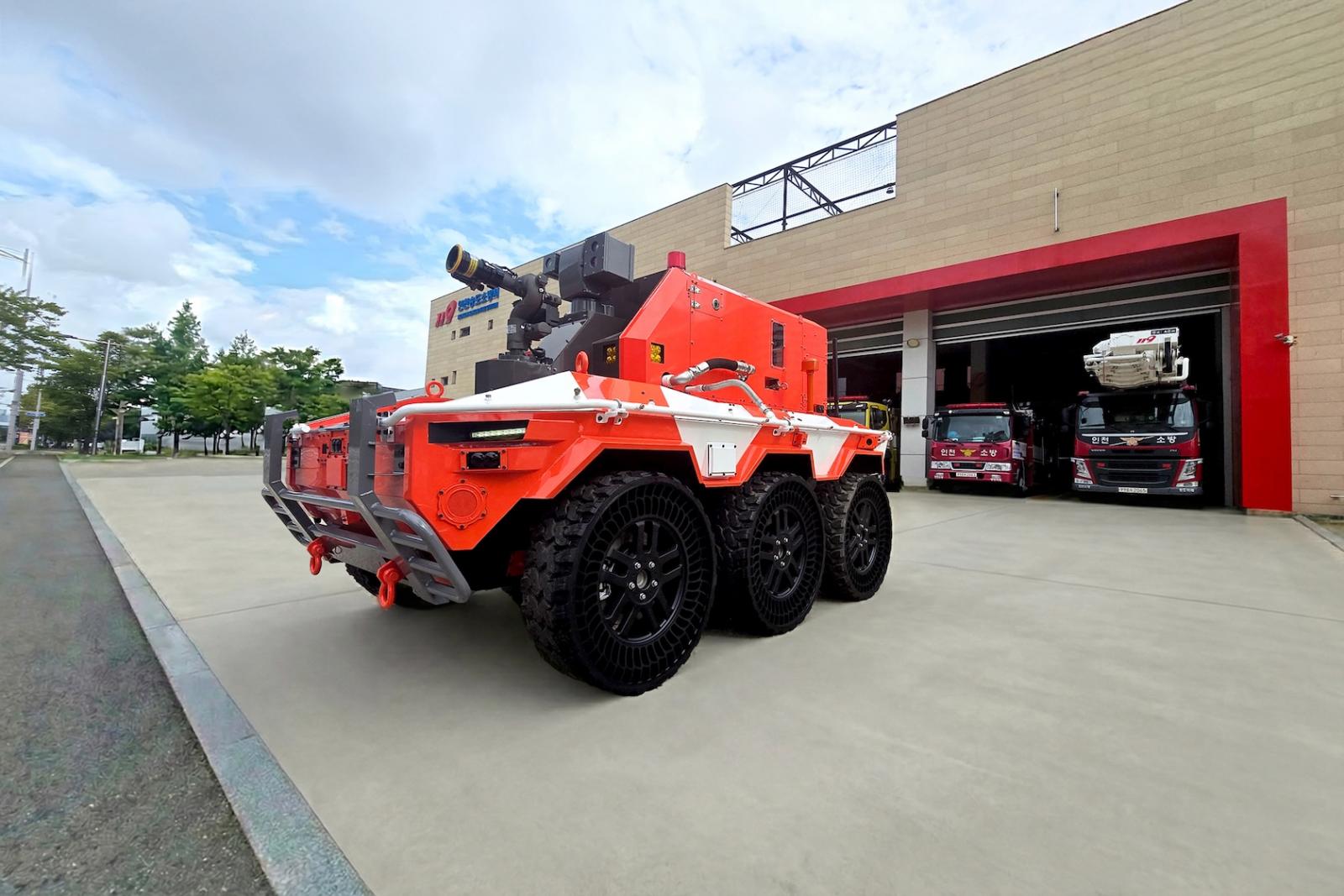
The Unmanned Firefighting Robot — based on ‘HR-SHERPA’, a multi-purpose unmanned vehicle developed for military use — integrates ‘unmanned electrification technology’ with remote operation, vision enhancement, and a thermal management package. To operate in high-temperature environments, its body features a self-spraying water-cooling system and insulation structure, providing heat resistance of up to 800 degrees Celsius — supporting safe operation of its battery and electric control systems.
Key technologies include Advanced Self-driving Assistance System, AI Vision-enhancing Camera, High-Pressure Self-illuminating Hose Reel and a 6×6 In-wheel Motor System.
The Unmanned Firefighting Robot is more than just a fire suppression tool; its core value lies in its function as a ‘data acquisition platform’ that digitizes disaster scenes. In the future, it is expected to evolve into a more advanced ‘fire response platform’ by continuously using machine learning to analyze on-site data such as smoke volume, fire scale and temperature.
CARLIST THOUGHTS
The future vision shared by the Group, the National Fire Agency, and the National Fire Research Institute is the introduction of a fully autonomous system. The plan is to advance the platform into a ‘true unmanned firefighting robot’ that, upon deployment, can independently assess situations, analyze the fire’s origin and suppression priorities, and calculate the most efficient method to extinguish the blaze on its own.