 Peter Lyon
January 20, 2023
Peter Lyon
January 20, 2023
- Many mayors favor less controversial policies, like replacing gas-guzzling vehicles with fully electric alternatives
- Eighty-seven percent of Democratic mayors see a need for significant financial investments in climate action, vs. 43% of Republicans
- Big gap between what mayors say they wish they could do, and what they think is realistic
American mayors are in a dilemma. A new poll shows Many want to take forceful steps to fight climate change — like banning gas stoves or leaf blowers — but fear such policies would be politically detrimental.
They do favor less controversial steps, like replacing gas-guzzling vehicles with fully electric alternatives and supporting solar power, according to the early findings from the 2022 Menino Survey of Mayors, a nationally representative survey of U.S. mayors.
The brutal realities of the election cycle prompt many officials to gravitate toward policies that won’t alienate their voters — even in the face of extreme weather events and climate risks that threaten their cities and constituents.
The 2022 Menino Survey of Mayors, named after former Boston Mayor Tom Menino, found broad consensus that humankind is contributing to climate change — nine out of 10 respondents agreed — but partisan differences in what to do about it.
Eighty-seven percent of Democratic mayors see a need for significant financial investments in climate action, vs. 43% of Republicans. Mayors on both sides of the aisle support replacing municipal vehicles with more fuel-efficient ones (75%).
But Democrats are far more likely to support a variety of other measures, such as requiring that new construction be solar-ready or using local money to support private home energy upgrades.
The survey — released this week to coincide with the annual winter meeting of the U.S. Conference of Mayors — reflects a big gap between what mayors say they wish they could do, and what they think is realistic. One mayor told the pollsters they “wanted to ban leaf blowers” but “did not have the support.” Another — described as “a progressive big-city mayor” — said of oil and gas restrictions: “We’re not doing it, but ultimately, it’s the right thing to do.” A third said restrictions on gas and oil would flop and that they “would be hung” for going after lawn tools.
Republican mayors overwhelmingly oppose restrictions on gas stoves, gas and oil heat, and gas-powered lawn tools. They also reject moves aimed at reducing car use, such as congestion fees and higher parking prices. Between a third and a half of Democratic mayors also oppose such restrictions.
The reality is that nearly all mayors worry about climate impacts on their cities — only 3% said they did not. Seventy-three percent of mayors agree that cities should be willing to expend resources and incur costs to address climate change. Meanwhile, fifty-five percent agree that making “real progress on climate issues” will require that residents “make real sacrifices.” (26% disagree.)
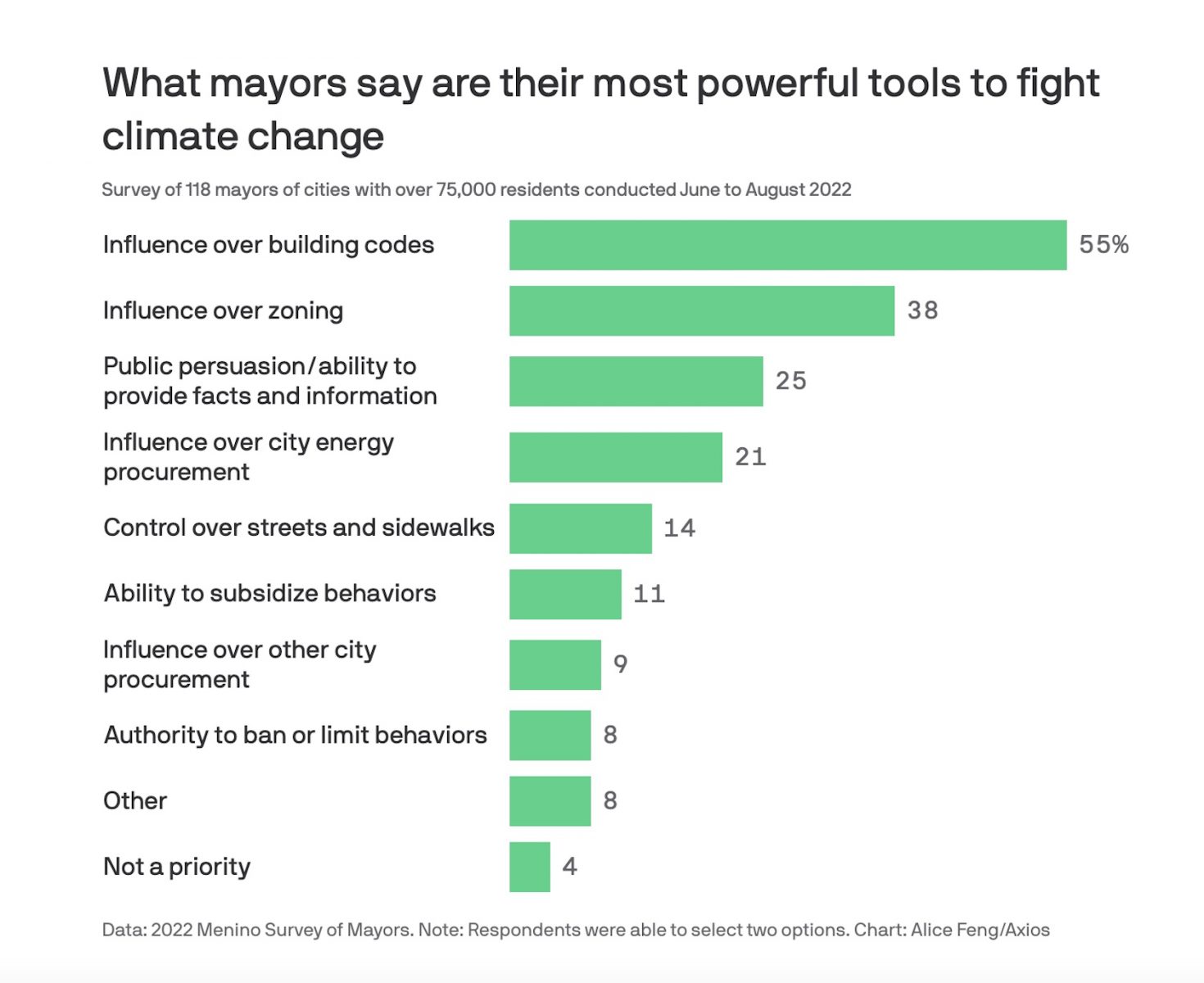
Mayors from both parties strongly support purchasing electric school buses, fire trucks, and public works vehicles. Many mayors see their influence over building codes as their most powerful climate tool (55%), followed by influence over zoning (38%), their own powers of public persuasion (25%), and influence over procurement (21%). Only 8% cite their authority to ban or limit behaviors — like driving or using gas appliances — as a useful tool.
“Mayors in general, across party lines, are eager and committed to taking steps at the local level to fight climate change,” David Glick, co-author of the Menino Survey and associate professor of political science at Boston University. But “we’re also seeing that there are limits — that they are constrained by politics, by money, and by other realities.”
For the record, the 2022 Menino Survey included 118 mayors of U.S. cities across 38 states with populations of more than 75,000.
OUR THOUGHTS
When did replacing gas-guzzlers with EVs become a ‘less’ controversial policy? I mean, over 90% of the population still drive cars with internal combustion engines, whether they be naturally aspirated or hybrid. And when I read the section—“These results reflect a big gap between what mayors say they wish they could do [to help combat climate change], and what they think is realistic,” I thought to myself, “dear me, what chance do we have” when the majority of mayors lack the courage to tackle urgent climate issues. If they can’t make a few sacrifices to save the climate, then how can they ask us to?